
McMinn Projected Versus Actual Release
A projected date is a current calculation. An actual release date records an event that already happened. McMinn County's automated jail information system may announce a projected release date for an indexed booking. TDOC FOIL may show sentence, release, expiration, or parole-related dates for a state felony record. The signed court judgment supplies the sentence and jail credit. Those sources answer related questions, but they are not interchangeable.
A pretrial detainee usually has no fixed sentence-release date. Bond, a dismissal, a plea, a later judgment, or a hold from another agency may determine the next custody event. A sentenced person can have a computed projection, yet credits, later court orders, parole action, or a detainer can change what happens. If a county roster entry disappears, investigate release or transfer. Silence is not proof.
Scheduled is not actual. Report a future date with its exact agency label and retrieval time. Confirm the later release through the jail, TDOC, or receiving agency record.
Find McMinn Projected Release Dates
Identify the custody system before searching. For a McMinn County Jail booking, use the sheriff's automated line and the court judgment. For a Tennessee felony sentence, use TDOC FOIL. FOIL covers current and former state felony offenders, while the county jail channel covers local bookings. A short misdemeanor or pretrial stay may never appear in FOIL.
- Collect the exact name, birth date, booking or TOMIS number, case number, and approximate custody dates.
- For county custody, call the automated jail line at (423) 252-5115 and transcribe the field exactly as stated.
- For state custody, search FOIL by name or identifier, open the matching TDOC record, and copy each date label without renaming it.
- Obtain the signed judgment from the McMinn Circuit Court Clerk. Check the offense date, sentence, jail credit, and whether terms run at the same time or one after another.
- Ask the holding agency which sentence, credits, and holds produced its calculation. After the date passes, confirm the actual custody event.
The county's historical OffenderIndex can show Sentence > Release Date and History > Previous Release Dates for an ended booking. It does not visibly explain the release reason. Use the sheriff event record and court file when bond, sentence completion, or transfer must be distinguished. The full county verification path is on the McMinn released-inmate search page.
Note: A date from one system applies only to that agency's custody or supervision record.
McMinn Jail Date by Phone
McMinn County has a specific local advantage: the sheriff's official page states that its automated inmate-information line includes projected release dates. The service runs all day, every day, but that availability must not be confused with a recent-release list. Use inmate-specific prompts and write down the exact date, wording, and time of the call. The line also provides charge, bond, and court information that can help identify why a projection may not describe a sentenced release.
After the projection, return to the county archive or request the recorded event. A release date in an ended booking confirms the end of that identified jail episode. It may still represent transfer to TDOC, another county, federal custody, or immigration custody. Ask for the release time, reason or authority, and destination when those fields exist and are public. If the jail data and judgment differ, preserve both labels and ask each custodian to explain its own record.
McMinn Court Sentence Dates
The judgment is the legal starting point for a sentenced McMinn case. The Circuit Court Clerk maintains Circuit, Criminal, General Sessions, Juvenile, Traffic, and Child Support records, so a request must identify the right docket. General Sessions handles many early and bond matters. A felony disposition may move into Criminal Court. Use the case number when possible and request the signed judgment plus later orders that affect sentence length, jail credit, probation, or revocation.
Jail credit is time the judgment or agency recognizes toward the sentence. Concurrent terms run at the same time, while consecutive terms run one after another. Those labels materially change a calculation. A docket can also show bond, dismissal, plea, verdict, and sentence information, but it may not contain the jail's actual door-out time. That timestamp belongs to the custody event record.
Do not calculate a final date from the judgment alone when credits or holds remain disputed. Compare the signed order with the jail or TDOC sentence summary. If a court later corrects the judgment, note the entered date and ask the holding agency when its projection was updated. A dismissal in one case also does not rule out another hold. The correct claim stays narrow: the judgment explains what the court ordered, and the agency record explains when custody actually changed.
McMinn Release Credits Differ
Tennessee sentence-reduction credits are governed by Tenn. Code § 41-21-236. In eligible cases, the statute allows the warden to award up to eight days per month for good institutional behavior and up to eight more for satisfactory program performance. Credits are documented, may be lost, and are not automatic rights. Education and program provisions, limits, offense dates, and sentence lengths also matter.
Under the current cited text, treatment differs for offenses before July 1, 2024, later offenses with sentences of two years or less, and longer sentences for offenses on or after that date. For the last group, credits affect parole eligibility rather than sentence expiration. The statute also addresses eligible felony offenders serving locally, pre-sentence felony jail time supported by jail-administrator records, and misdemeanants. A misdemeanor court can set a release percentage from 30 to 100 percent, subject to statutory credit limits.
These rules make a generic calculator unsafe. The actual judgment, conviction offense, offense date, jail credit, award and loss history, concurrent or consecutive structure, and any holds must be known. A projected McMinn County release date should be transcribed from the agency calculation, not rebuilt from a broad rule of thumb.
The manifest image from the sentence-reduction credit statute shows the legal source that must be matched to the individual sentence.
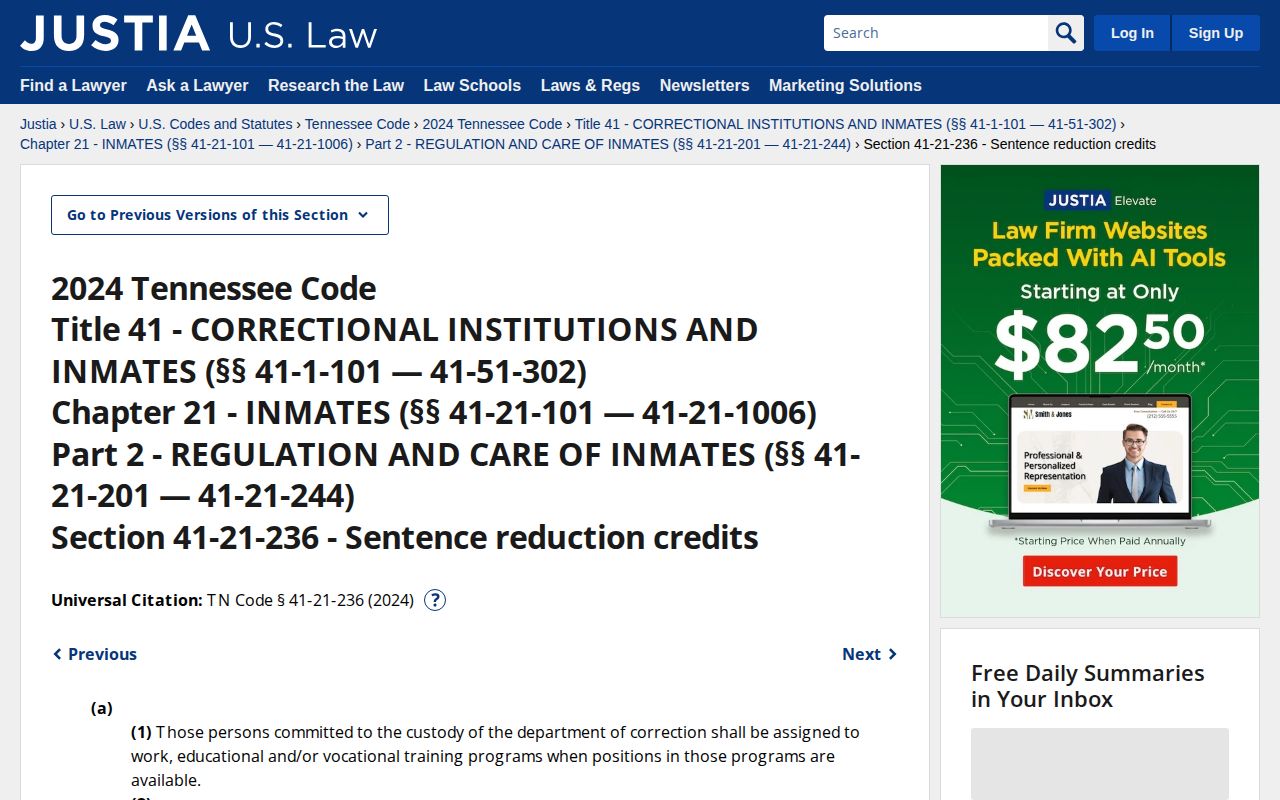
The statute image supports the framework. It does not calculate a person's date.
McMinn Truth-in-Sentencing Dates
Tennessee does not have one universal “serve 85 percent” rule. Release eligibility under Tenn. Code § 40-35-501 varies with the offense, offense date, classification, exclusions, and later amendments. Public Chapter 988, the 2022 Truth in Sentencing Act, imposed 100-percent service rules for listed offenses committed on or after July 1, 2022, and offense-specific 85-percent rules for others. Many cases fall under different provisions.
The General Assembly bill history documents that enactment. Match the judgment's exact offense and offense date to current law before drawing any conclusion. Parole eligibility is also not physical release. A Board grant can still depend on final votes, a certificate, and an approved release plan.
A legal percentage may explain part of a calculation, but it cannot reveal a later detainer, corrected judgment, new case, or credit loss. The agency holding the person owns the current operational projection.
Why McMinn Release Dates Move
A projection changes when one of its inputs changes or when another authority controls the next move. Some changes affect the mathematical date. Others change whether the person walks into the community or enters another form of custody. Record the reason supplied by the responsible office rather than guessing from a roster.
| Factor | Possible effect | Record to check |
|---|---|---|
| Credit award or loss | May move eligibility or expiration under the governing statute. | Institution or jail credit record |
| Corrected court order | Can change sentence length, jail credit, or how terms run. | Signed judgment and later docket order |
| Concurrent or consecutive cases | Terms may overlap or run one after another. | Each judgment and agency sentence summary |
| Parole action | A denial or deferral delays parole; a grant may remain conditional. | Final Board record and release certificate |
| Detainer or new hold | The person may transfer instead of entering the community. | Release event and receiving-agency record |
| Revocation or new case | Custody and sentence calculations may change. | Court, Board, TDOC, and jail records |
FOIL can label a person incarcerated even after the McMinn roster drops the local booking. That pattern points to a state transfer, not county release into the community. BOP dates concern sentenced federal custody. ICE ODLS concerns immigration detention. The court explains legal disposition, while the sheriff records the county jail event.
McMinn Reentry Supervision Date
A custody end date may begin supervision rather than end all state control. Tenn. Code § 40-35-506 provides a mandatory reentry-supervision framework for covered felony offenses committed on or after July 1, 2021, subject to the statute's terms and exceptions. The person can leave confinement while remaining active in FOIL under a community status.
Use release paperwork to identify the reporting duty and office. McMinn County's TDOC community-supervision contact is at the Criminal Justice Center in Athens. A public lookup helps verify the broad status, but it should not replace a person's own release instructions or expose confidential reporting details.
The manifest capture of the mandatory reentry statute illustrates why a custody date and supervision-end date can differ.
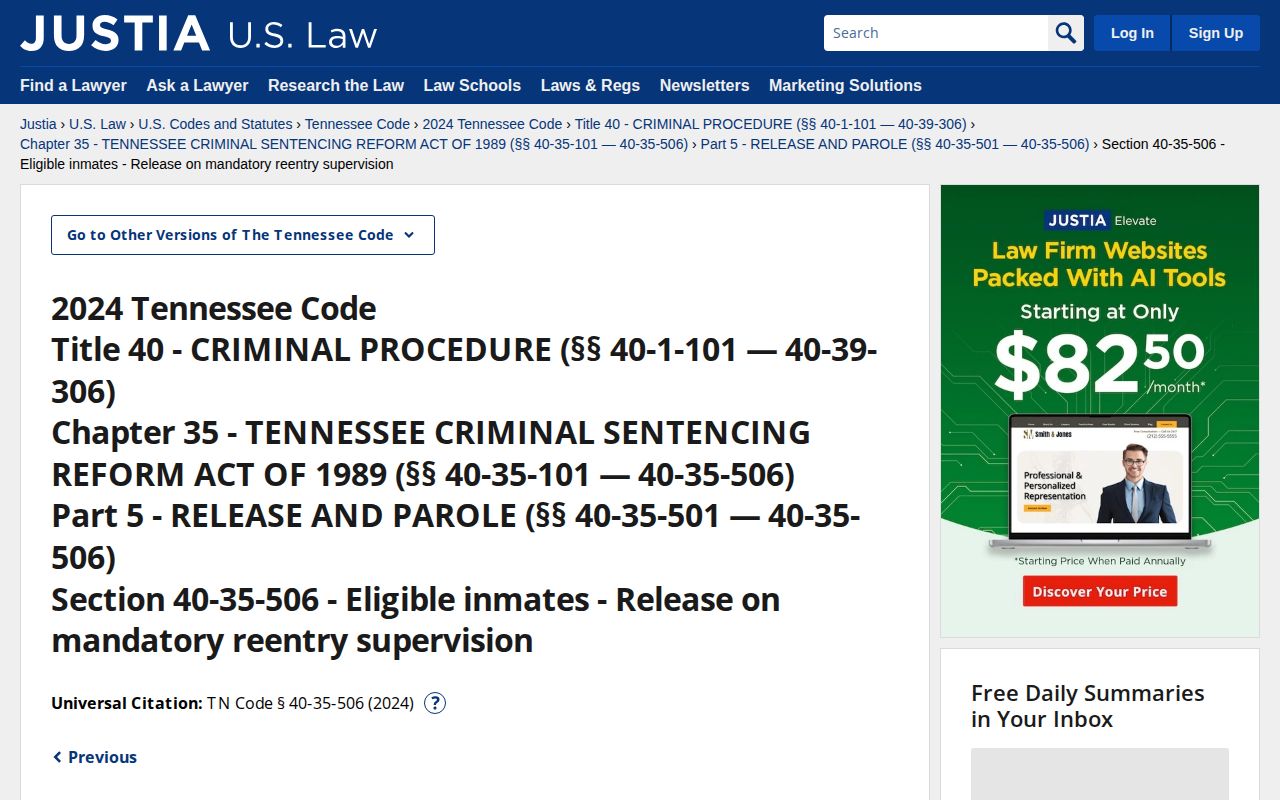
The statute defines a category of supervision. The matching judgment and TDOC record determine whether it applies.
Confirm McMinn Actual Release Dates
After the projected day, check the system that held the person. For the county jail, inspect the historical record for Release Date or Previous Release Dates, then request the sheriff's event record if the reason or destination matters. For a state prisoner, review FOIL and obtain the TDOC release record or certificate when a precise event must be documented. Keep the retrieval time with each result.
VINE can send a custody-change alert for participating agencies. Registration and limits are explained on the McMinn VINE inmate check. An alert is a prompt to verify, not certified proof. A transfer alert should lead to the receiving system. A release alert should be compared with the jail or TDOC event.
If sources conflict, preserve their exact labels. Ask the jail about physical movement and ask the clerk about the legal sentence. McMinn sheriff records answer county custody; FOIL answers Tennessee felony custody or supervision; BOP answers sentenced federal custody; ICE ODLS answers immigration detention; and the court answers disposition. A recorded date confirms only the identified custody episode.